Augment Code CEO Matt McClernan on the shift from copilots to agent orchestration
Augment Code CEO Matt McClernan discusses the rapid shift from AI code completions to agent orchestration at HumanX 2026, interviewed by WorkOS CEO Michael Grinich.


When Augment Code launched in late 2024, the ceiling for most AI coding tools was autocomplete. A year and a half later, developers are managing teams of parallel agents. At HumanX 2026, WorkOS CEO Michael Grinich sat down with Augment Code CEO Matt McClernan to talk about what changed, what enterprises actually look like on the inside, and where the industry goes from here.
From code completions to agent orchestration
The progression has been fast. IDE-based completions gave way to chat-based agents, then CI-integrated automation, and now—with models like Opus—full agent orchestration. Developers aren't writing code line by line anymore. They're directing agents.
"We've seen this realization that we can move beyond the developer interacting in real time in the codebase," McClernan said. "Developers are driving the bulk of their work through agents and guiding those agents."
This isn't a subtle shift. It changes the fundamental unit of developer productivity from lines of code to quality of direction.
Context is the moat
Augment Code's bet is that the real bottleneck isn't model capability—it's context. Enterprise codebases are massive, proprietary, and constantly changing. Frontier models weren't trained on them. No amount of parameter count fixes that.
Augment built custom retrieval models that surface the right context to LLMs in real time. The goal: give developers the experience of pair-programming with a senior engineer who deeply understands their specific codebase, not just code in general.
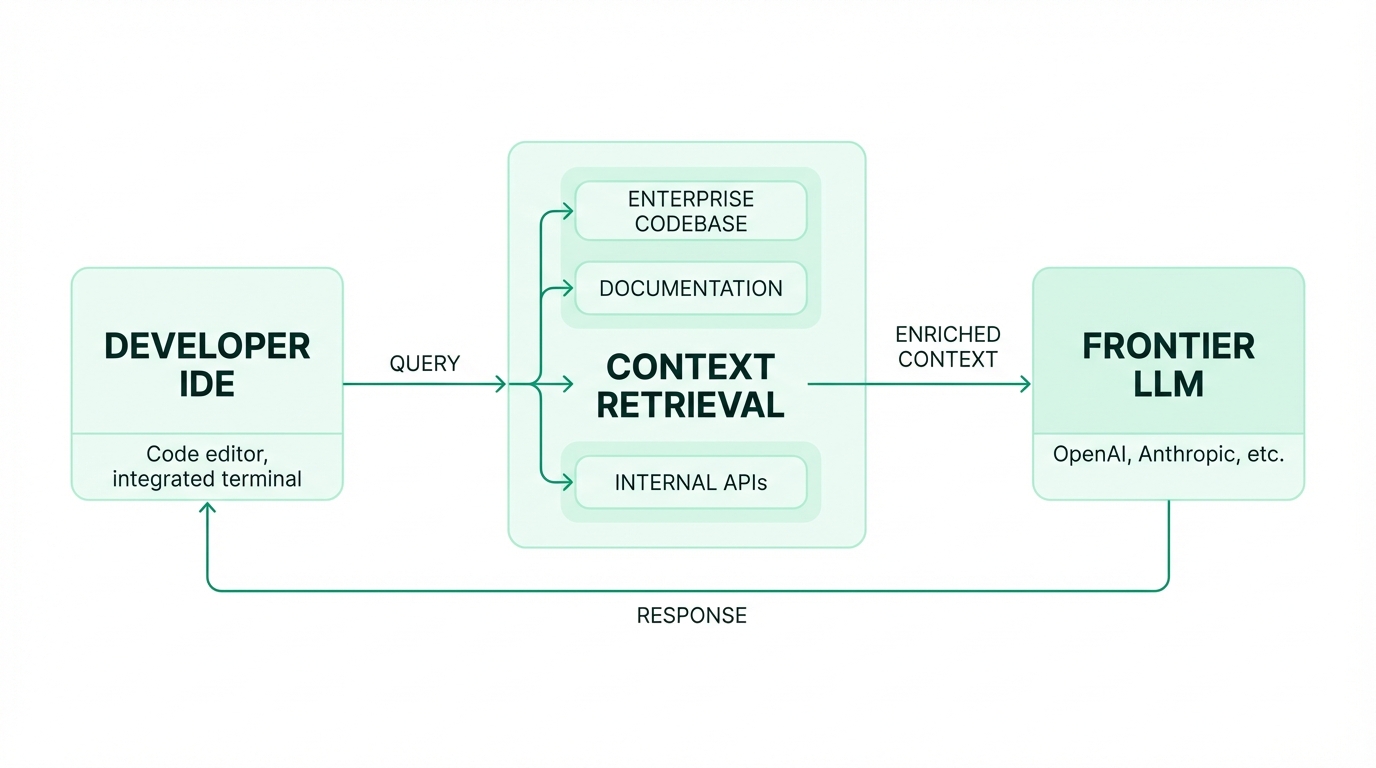
One strategic decision stands out. About a year ago, Augment stopped training its own coding models entirely. They went all-in on frontier labs.
"We saw the advantages of working with frontier labs," McClernan explained. "By not competing with them, we could truly become friendly with them."
It's a classic build-vs-partner decision, and McClernan is clear-eyed about why it worked: the rate of improvement in frontier models made competing on the model layer a losing game for a company of Augment's size. Augment's value is in the retrieval and context layer that sits on top.
The changing profile of a software engineer
This shift has real consequences for hiring—including at Augment itself. The attributes that matter most in a developer are changing. Pure coding speed matters less. Judgment matters more.
Systems design decisions. Product thinking. Writing detailed specs that give agents the precise instructions they need to execute correctly. "The profession becomes much more about that," McClernan noted.
The developers who thrive when working through agents that run tasks autonomously aren't necessarily the fastest typists—they're the ones who can decompose problems cleanly, evaluate agent output critically, and make the architectural calls that agents can't.
Enterprises are not lagging behind
According to McClernan, enterprises are at the forefront of AI coding adoption. Not trailing. Not cautiously experimenting. Leading.
McClernan described financial institutions in the Midwest, media companies on the East Coast, and a large furniture company—all actively building toward software engineering organizations where agents handle the bulk of implementation work. These aren't Silicon Valley startups with nothing to lose. They're large, regulated, risk-aware companies making serious infrastructure bets.
"We have to step outside the confines of our bubble," McClernan said. "These stories are popping up all over the place."
The cost question
The biggest problem McClernan hears from executives isn't technical. It's financial. AI costs don't fit traditional annual forecasting models. Usage is spiky, hard to predict, and growing fast. Enterprises built their budgeting processes around predictable infrastructure costs, and AI systems that scale with usage break that assumption.
This is a real blocker. Companies that want to go all-in on AI coding tools need new frameworks for cost planning—and vendors need to help them get there.
What's next: model specialization
Looking ahead, McClernan sees frontier models becoming so capable in specific domains that they fragment the market. Instead of one general-purpose model to rule them all, we get a toolchain of specialized models—best-in-class for specific languages, frameworks, or even industries.
If that plays out, the context and orchestration layer becomes even more critical. Someone has to route the right task to the right model with the right context. That's exactly where Augment is positioning itself.
The full conversation is worth watching. The shift from copilots to agent orchestration is happening faster than most people expected, and according to McClernan, the companies adapting fastest aren't the ones you'd guess.