Duality AI: Building Reality-Grade Digital Twins for AI and Robotics
Duality AI provides high-fidelity digital twin simulation for robotics and embodied AI, enabling teams to generate synthetic data, test autonomy, and validate real-world behavior safely in virtual environments.
Duality AI offers a platform — Falcon — designed to simulate real-world environments at high fidelity so teams can build, test, and refine AI and robotic systems safely and efficiently.
Instead of gathering real-world data through expensive or dangerous physical tests, Falcon enables developers and researchers to operate in virtual “digital twins”: realistic, parametrizable environments that mirror physical laws, sensors, behaviors, and object dynamics.
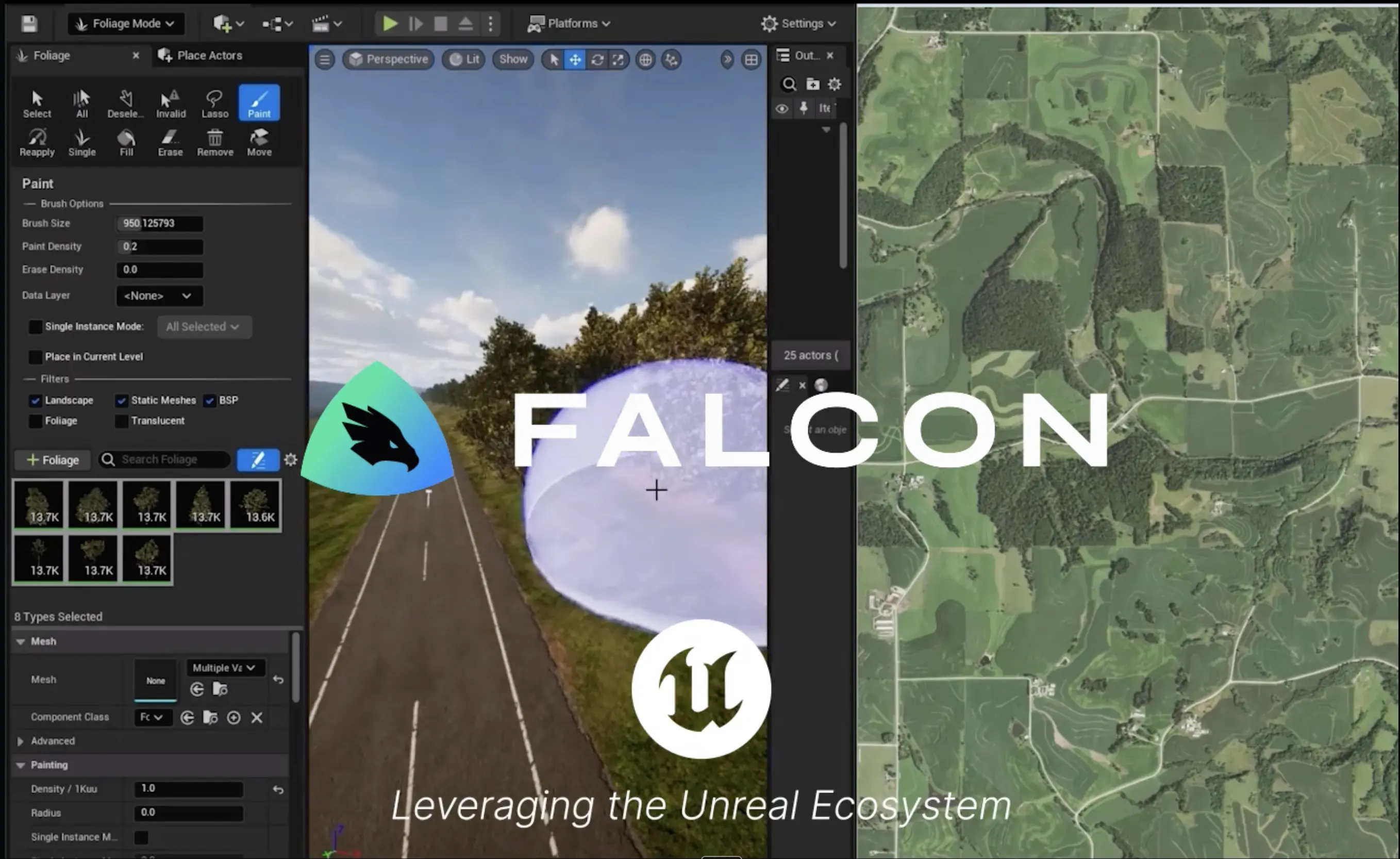
With Falcon, organizations can import or build simulation-ready assets (e.g. environments, robots, drones), compose scenarios, and run simulations to generate synthetic perception data, train models, or test autonomous behaviors — all without touching hardware or risking safety. This pipeline dramatically lowers the cost and time required for embodied AI, robotics, automation, or any system that must operate in the physical world.
Recent upgrades such as FalconEditor — built on top of Unreal Engine — and FalconCloud bring simulation to broader teams. FalconEditor simplifies digital-twin creation and scenario design, while FalconCloud enables users to run complex simulations from the browser, removing the need for specific hardware or local GPU setups.
These advances make Falcon a powerful tool for industries like robotics, autonomous vehicles, manufacturing, defense, drone detection, and anywhere that needs real-world-like data or validation long before deploying real hardware into uncontrolled, risky environments. For example, as of 2025, the U.S. Army has contracted Duality AI to use Falcon for developing drone-detection AI, using synthetic data from digital twins to accelerate testing and model training before any physical prototype is built.
Why Duality AI Alone Isn’t Enough — And Where WorkOS Fits In
While Duality AI handles simulation, synthetic data, and the “digital-twin plane,” it does not solve identity, access control, or enterprise governance. That’s where WorkOS becomes essential.
Working with embedded AI agents, robotics dashboards, simulation management consoles, or enterprise-facing SaaS built on top of simulation output demands robust authentication, authorization, and access-management infrastructure. WorkOS delivers exactly that: enterprise-grade user management, SSO (SAML/OIDC), directory sync (SCIM), multi-factor authentication, role- and resource-scoped permissions, and auditability — all via developer-friendly APIs.
In a scenario where a company uses Falcon to simulate environments, generate data, or test AI/robotic behavior — they also need to control which users (or internal teams, clients, external auditors, or AI agents) can view or modify simulation data, launch simulations, download synthetic data, or deploy outputs. WorkOS gives you a governance layer on top of the “digital-twin plane,” ensuring that access is secure, scoped, and auditable.
Moreover, as organizations scale — multiple teams, business units, contractors, or external partners — WorkOS makes it easy to integrate corporate identity providers (IdPs), enforce enterprise-wide security policies, and seamlessly onboard or offboard users. This saves engineering effort and reduces risk compared with building custom auth infrastructure from scratch.
In short: Duality AI gives you “what you build and test” — WorkOS controls “who builds, tests, and deploys.”
Combining Digital-Twin Simulation With Enterprise-Grade Auth: A Realistic Stack for Modern AI & Robotics
As AI and robotics systems get more ambitious — multi-agent drones, warehouse-scale automation, autonomous vehicles, simulation-trained perception models — you need a stack that covers both the compute/data infrastructure and identity/access governance.
Duality AI’s Falcon handles the simulation, synthetic data, and behavior modeling side. You get the ability to prototype, generate data, validate in closed-loop simulation, and iterate rapidly — without needing hardware, risking safety, or waiting for real-world deployments.
Once you’re ready to expose simulation tools, data dashboards, or model management to teams or customers: integrate WorkOS. With WorkOS, you get enterprise-ready auth, access control, permission management, user provisioning, role-scoped permissions, and IdP integrations — all without reinventing the wheel.
This combination delivers a robust, scalable architecture: real-world-level simulation + enterprise-grade identity + secure access + compliance readiness.
Why This Matters for Developers and Product Builders
For developers building next-gen AI or robotics platforms, the vision of shipping working AI that interacts with the physical world still demands both: realistic simulation and safe, flexible governance.
Duality AI empowers teams to move fast: iterate simulation, generate data, validate models — with less cost, less risk, and faster time-to-insights.
WorkOS empowers teams to ship to real customers — whether internal teams, enterprise clients, or external users — without getting bogged down by auth boilerplate, identity provider quirks, provisioning, or permission logic.
Together, they reduce overhead and let you focus on core functionality: building robots, AI agents, automation pipelines, or simulation-driven products — while trusting your identity and access layer to handle the rest.
Conclusion — Not Alternatives, but Layers
Duality AI solves a deep technical challenge: how to build, test, and scale embodied AI and robotics systems in virtual reality, using digital twins and synthetic data. It’s a big deal for any team working on autonomy, perception, computer vision, or robotics.
But simulation alone doesn’t make a secure, enterprise-ready product. That’s where WorkOS comes in — providing the identities, permissions, access controls, and compliance infrastructure necessary to safely expose simulation tools or AI/robotic pipelines to users.
If you’re building modern AI-driven or robotics-involved software — especially for enterprise or multi-tenant customers — using Duality AI and WorkOS together gives you a realistic, scalable, and secure foundation: build fast with simulation, ship safely with enterprise identity.