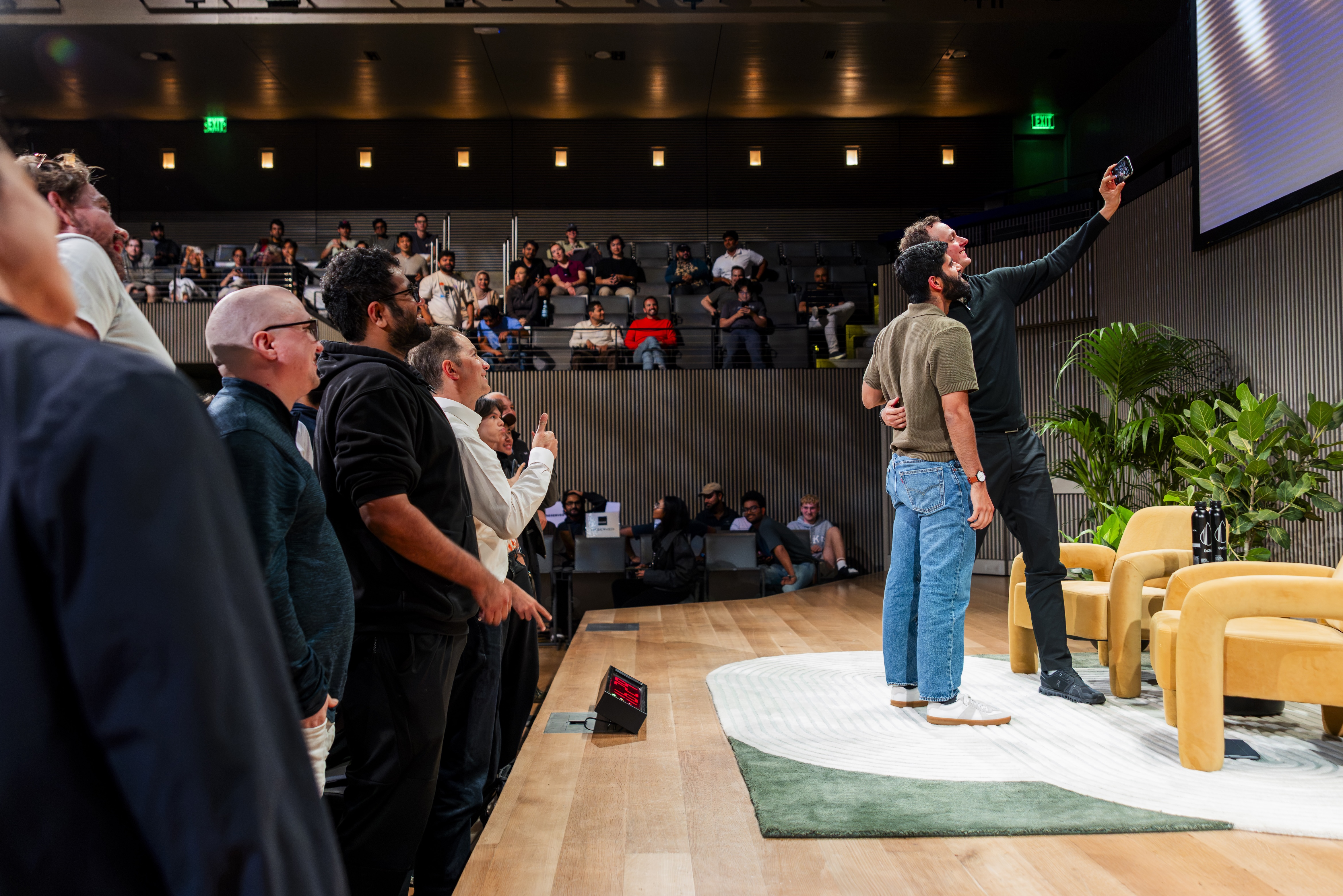
Dwarkesh Patel on the AI decade, in conversation with Michael Grinich
WorkOS CEO Michael Grinich sat down with Dwarkesh Patel. The big ideas: exponential acceleration, losing control, the right to bear weights, and abundance.

WorkOS founder and CEO Michael Grinich recently sat down with Dwarkesh Patel for a conversation at Dwarkesh Unplugged. Patel is one of the most listened-to interviewers in AI — about 1.4 million YouTube subscribers, over a billion views, guests ranging from Mark Zuckerberg to Satya Nadella to Demis Hassabis, Dario Amodei, and Ilya Sutskever, a book called The Scaling Era, and two turns on the TIME 100 AI list.
The conversation stayed high-altitude on purpose. Here are the ideas worth carrying out of it.

Exponential growth feels like standing still
Patel started his podcast in 2020 as a UT Austin student who landed his first guest with a cold email. Ask him when it "took off" and he shrugs at the premise: the trajectory has never felt that different from the inside. He does the same thing every day, and the intensity of the early years feels like the intensity now — the numbers are just bigger.
Grinich put the math on it. If you're accelerating exponentially, the derivative is constant. You're standing in a rocket at one G; you don't feel the speed, you feel the same steady push. That's why a company growing this fast can feel, day to day, like the same company it always was. It's a useful correction to the overnight-success story — the acceleration is real, and the people inside it rarely notice the inflection.
How to actually get an answer
Some of the most transferable material was about Patel's craft. When he interviews a CEO, he's not there because they understand the technology best — he's there because their position of influence matters, and he wants to know how they're making plans from that seat. He keeps pushing until he hits a concrete "nugget of insight," an instinct that turns out to be productive when your job is making things other people find interesting.
His prep trick is worth stealing for any hard subject: when there's no clear curriculum, find an adjacent project you can actually do. Before his first interview with Ilya Sutskever — back before GPT-4 shipped — he implemented a transformer, on the theory that if he could build the thing, he could hold the conversation. And he now writes the single make-or-break question at the top of his list: if he doesn't get a real answer to that one, the interview failed. He also noted that the tense moments feel far worse live than they look in hindsight. Increasingly, the podcast isn't the whole job — he's doing more original writing and analysis, because the questions AI raises are enormous and mostly nobody's job to think about.
The full-automation thesis
The center of gravity was Patel's view of where this goes. Within five, ten, or maybe twenty years, he expects AI to do everything humans can do. Follow that through and you get robots building robots and a world economy that could double every year or faster — because the human population can't jump from 7 billion to 7 trillion, but AI populations can. That opens up questions that don't have owners yet. His example: what's the optimal way to tax and redistribute in an economy with almost no human labor? The tools exist; almost no economist is pointing them at that future.

Losing control is the real risk — not extinction
Asked about p(doom), Patel reframed it. Asked about p(doom), Patel reframed it. He thinks an outright extinction scenario is very unlikely — the payoff for AI doing that is low. What seems genuinely plausible is losing control.
His picture: 7 billion humans vastly outnumbered by trillions of AIs that do all the work, coordinate better with each other than with us, and think far faster — leaving humans as a small minority extracting the surplus while contributing nothing net productive. Historically, that's the setup for an uprising. The hope is that there are better and worse ways to lose control. Individuals don't have much control over the world today either, yet our rights are respected and our ability to do interesting things is protected. The goal is to land humans somewhere similar in an automated future.
Alignment gets harder when models never stop learning
Patel's most specific worry is about what comes after frozen weights. Today's alignment optimism, he argued, rests on getting a fixed set of weights to behave. But models will eventually learn on the fly the way people do — changing from their interactions and experience in the world. He compared it to raising a child who then goes out into the world and might get indoctrinated or fall in with the wrong crowd.
The hardest problem is a communication problem
The note the conversation kept returning to: AI is deeply unpopular. Patel cited a report ranking it near the bottom.
Patel's read is that nobody has clearly articulated how ordinary people benefit. The challenge has two halves: describing the abundance on the far side, and catching the people whose jobs get automated on the way there. His honest version of the optimistic case is almost mundane — life is better now than in 1500 because there's more technology, more stuff, more abundance, and AI is more of that. The risk he flagged is political, not technical: if AI gets unpopular enough that America stops building data centers, the world's future labor force ends up somewhere else — which he called dangerous.
That's the throughline. The technical curve looks almost settled to Patel. Whether the rest of us come along is a question of trust, access, and who gets to hold the weights — and those aren't problems the exponential solves on its own.