NetScaler's SAML zero-day: What CVE-2026-88779 means for anyone running SAML
Citrix has patched an actively exploited memory overflow in the SAML handling of NetScaler ADC and Gateway. It is the fourth NetScaler SAML vulnerability this year, and the pattern says a lot about where authentication code breaks.

!!Update, October 12, 2026: On October 8, Citrix published a second SAML bulletin, CTX697191, for CVE-2026-107406. It is a memory overflow that Citrix says may lead to remote code execution or denial of service, with a CVSS 4.0 base score of 9.5. The builds this post first listed as fixed for CVE-2026-88779 (14.1-73.41, 13.1-64.28 and their FIPS equivalents) are still affected by CVE-2026-107406 when the appliance is configured as a SAML identity provider. The fixed builds are now 14.1-73.46, 13.1-64.29, 14.1-73.46 FIPS and 13.1-37.283. As of October 10, Citrix said it was not aware of exploitation, and the CVE was not in CISA’s Known Exploited Vulnerabilities catalog. CISA added it to its NetScaler alert on October 9. We’ve updated the tables and steps below.!!
On October 3, 2026, Citrix published a security bulletin for CVE-2026-88779, a memory overflow in NetScaler ADC and NetScaler Gateway appliances that are configured for SAML. A day later, CISA added it to the Known Exploited Vulnerabilities catalog and gave federal civilian agencies until October 7 to patch.
The timing makes this one painful. Many NetScaler administrators had just finished an emergency upgrade for a separate batch of vulnerabilities, CVE-2026-88771 through CVE-2026-88778, which Citrix fixed on September 27. If those appliances use SAML, they need to be upgraded again.
The facts at a glance
What happened
The disclosure came out of an incident that was already under way. Security researcher Kevin Beaumont named it "PitScaler," and Tenable has been tracking it in a running FAQ.
Denial of service or something worse?
Citrix describes CVE-2026-88779 as a memory overflow that leads to denial of service, and its CVSS vector scores no confidentiality or integrity impact. Early reporting was less certain. Beaumont said one of his patched honeypots was running a downloaded malware binary, which led to speculation about code execution.
watchTowr has since said it reproduced the bug and found that it can only crash systems. According to SecurityWeek, watchTowr suspects attackers used it to crash machines on purpose, to speed up exploitation of CVE-2026-88771.
That reading still matters for defenders. A SAML bug that "only" crashes the appliance can be one step in a chain, so a crash on a NetScaler that sits in front of your authentication is worth investigating.
!!Why the DoS label deserves some caution. This has happened before on NetScaler this year. Citrix first described CVE-2026-8452, another SAML flaw, as causing "unpredictable behavior or denial of service." In August, watchTowr's binary analysis showed it was a heap buffer overflow that a single malformed SAML message could turn into unauthenticated code execution as root. CISA added it to KEV on August 26.!!
Five days after this bulletin, Citrix disclosed a second SAML memory overflow, CVE-2026-107406, and this time its stated impact includes remote code execution. Citrix has not said whether the two bugs are related, or whether the second is an incomplete fix for the first. It has published no technical details on CVE-2026-107406.
Are you affected?
Only appliances with a SAML service provider or identity provider configuration are exposed. You can check the saved configuration and the running build from the appliance:
A samlAction line means the appliance is a SAML service provider. A samlIdPProfile line means it is a SAML identity provider. Which CVEs apply depends on both the build and the role:
Builds in the “SP or IdP” column are affected by both CVE-2026-88779 and CVE-2026-107406. Citrix’s CVE record lists every 14.1 build before 14.1-73.46 as affected, so treat 14.1-73.42 through 14.1-73.45 as vulnerable too. Citrix-managed cloud services and Citrix-managed Adaptive Authentication are patched by Citrix. Secure Private Access hybrid deployments that use your own NetScaler instances are in scope.
What to do now
- Upgrade to 14.1-73.46 or 13.1-64.29, even if you patched last week. Neither the September 27 builds nor the October 3 builds fix CVE-2026-107406 on an appliance configured as a SAML IdP. If you moved an IdP to 14.1-73.41 or 13.1-64.28 for CVE-2026-88779, it needs another upgrade.
- Use interim mitigations only as a bridge. Citrix has offered Global Deny List signatures as a temporary mitigation for CVE-2026-88779, according to BleepingComputer, and practitioner guidance also describes a responder policy that Citrix Support provides. Citrix’s bulletin for CVE-2026-107406 lists no workaround, so upgrading is the only fix.
- Look for crashes. Practitioner write-ups point to crashes of the
nsaaadauthentication process in/var/log/ns.logor/var/log/messages, repeated daemon restarts followed by reboots, and "Pitboss declaring system failure" messages. - Treat unexplained reboots as a lead. If an appliance has rebooted unexpectedly since late September, investigate it for CVE-2026-88771 compromise as well, given watchTowr's view that the crash may have been used to speed up that attack.
The bigger pattern: Five SAML vulnerabilities in seven months
CVE-2026-107406 is the fifth NetScaler vulnerability in 2026 that requires a SAML configuration, and the second in a single week. Three of the five have been exploited in the wild.
These bugs keep landing in the same place for a structural reason. A SAML endpoint has to decode, parse and canonicalize XML that an unauthenticated stranger sent before it can check the signature that would tell it whether to trust that XML. Every step before the signature check runs on attacker-controlled bytes.
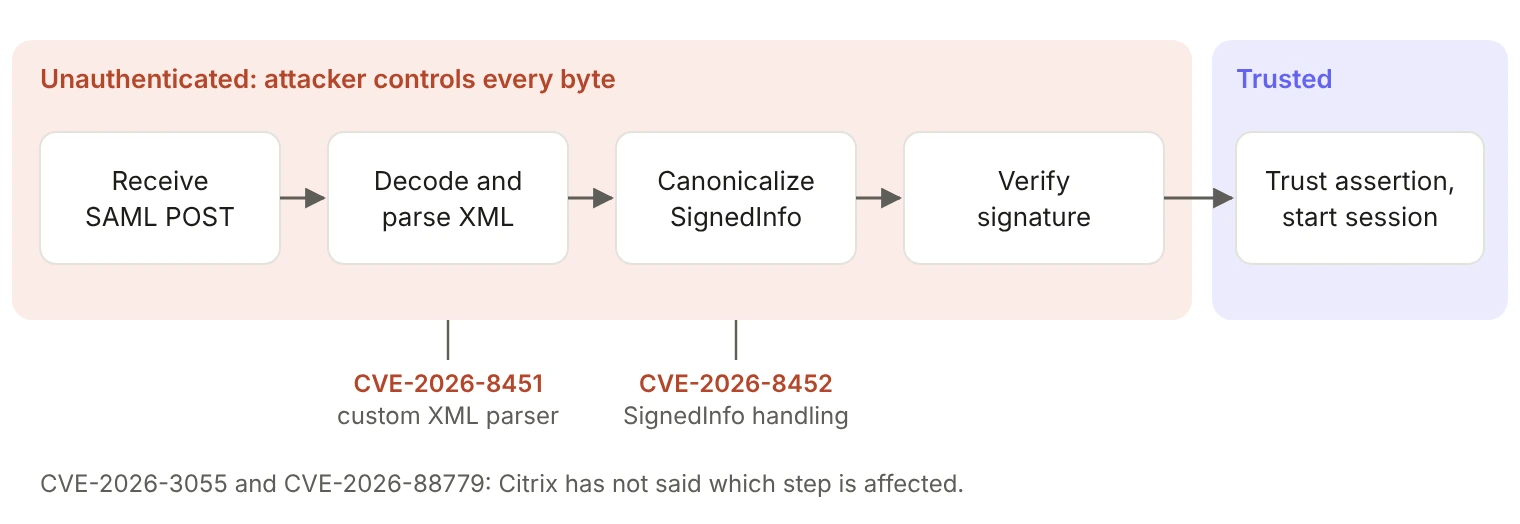
This is the core of Trail of Bits' recent argument that SAML is "a fractal of bad design": XML signatures depend on canonicalization, and parsers that disagree about a document's shape create room for attacks. We agreed with the diagnosis in our response, while arguing that SaaS vendors still have to support SAML because their enterprise customers require it. NetScaler's year shows the other half of that argument: if you have to support SAML, the code that handles it deserves the same scrutiny as any other internet-facing parser.
What this means if your product accepts SAML
NetScaler is an appliance, but the lesson applies to any application that acts as a SAML service provider. If your B2B product offers enterprise SSO, your SAML endpoint also accepts XML from anyone on the internet before it knows who sent it.
Keep untrusted XML handling small and boring
- Use a well-maintained, widely deployed SAML library, keep it current, and do not write your own XML parser or canonicalizer.
- Cap the size of incoming SAML messages and reject document type declarations and other XML features that SAML does not need.
- After the signature checks out, read claims only from the element the signature covers, not from another part of the document.
- Fuzz the endpoint, or confirm that your library's maintainers do.
Plan for your customer's IdP going down
This bug's stated impact is availability. If a customer's identity provider or SAML gateway is down, every one of their users is locked out of your product too. Decide ahead of time how a verified administrator gets in during an IdP outage, and make sure that path is logged and cannot be used to quietly bypass SSO enforcement.
Or take the parser out of your codebase
Another option is to delegate the protocol entirely. WorkOS SSO acts as authentication middleware between your app and your customers' identity providers. It handles the SAML or OIDC exchange, and your app receives a normalized profile through a standard OAuth 2.0 style code exchange. Your remaining job is the authorization check: the WorkOS docs recommend always validating the returned profile's organization ID rather than trusting email domains.
The takeaway
If you run NetScaler with SAML, upgrade to 14.1-73.46 or 13.1-64.29 (or the matching FIPS build) now, even if you patched in September or last week, and investigate unexplained reboots. An appliance that acts as a SAML identity provider on the October 3 builds is still exposed to CVE-2026-107406.
If you build software that accepts SAML, NetScaler’s 2026 is a reminder that the riskiest code in the login flow runs before you know who you are talking to. Keep that code small, current and well tested, or hand it to someone whose job is maintaining it.
Sources
- Citrix security bulletin CTX697174 for CVE-2026-88779
- CISA: CISA adds one known exploited vulnerability to catalog (October 4, 2026)
- The Hacker News: New NetScaler zero-day exploited in targeted attacks
- BleepingComputer: Citrix patches NetScaler SAML zero-day exploited in attacks
- SecurityWeek: Exploitation of Citrix NetScaler zero-day hits appliances patched days earlier
- Tenable: PitScaler, Citrix NetScaler zero-day vulnerabilities FAQ
- watchTowr Labs: Citrix NetScaler pre-auth command injection CVE-2026-88771
- Poppelgaard: CVE-2026-88771 through CVE-2026-88779, what you should know
- Canadian Centre for Cyber Security: AL26-006, CVE-2026-3055
- Beazley Security Labs: CVE-2026-8451 advisory
- Cloud Security Alliance: CitrixBleed Infinity, CVE-2026-8451
- Cloud Security Alliance: CVE-2026-8452 exploited
- Trail of Bits: SAML, a fractal of bad design
- WorkOS: Trail of Bits is right about SAML. You still have to support it.
- WorkOS: SAML's rough quarter
- WorkOS SSO documentation
- Citrix security bulletin CTX697191: CVE-2026-107406
- Citrix: Immediate guidance for CVE-2026-107406
- CISA: Critical zero-day vulnerabilities exploited in Citrix NetScaler ADC, Gateway (updated October 9, 2026)
- MS-ISAC advisory 2026-110