Ojus Save on how render is rethinking cloud for AI workloads
Ojus Save from Render explains how the platform is evolving cloud infrastructure for AI workloads, GPU access, and developer experience at HumanX 2026.


The cloud infrastructure market is shifting fast. AI workloads have fundamentally different requirements than traditional web apps — GPU access, burst compute, model serving — and most cloud platforms weren't built for this. We sat down with Ojus Save from Render at HumanX 2026 to talk about how they're adapting.
The problem with cloud for AI
Cloud platforms were originally designed around stateless web services and long-running containers. You push code, it scales horizontally, and you pay for uptime. AI workloads break that model in several ways: they need GPUs, they're bursty, they require loading large model artifacts into memory before serving, and the cost profile — driven by GPU-hour pricing — looks completely different from serving a REST API.
For most developers building AI-powered products, that means stitching together GPU providers, model hosting services, and traditional cloud platforms — a fragmented stack that's painful to manage.
Render has been making a name for itself by simplifying cloud deployment for developers, and Ojus Save walked Saif Gunja through how they're extending that simplicity to AI workloads.
What render is doing differently
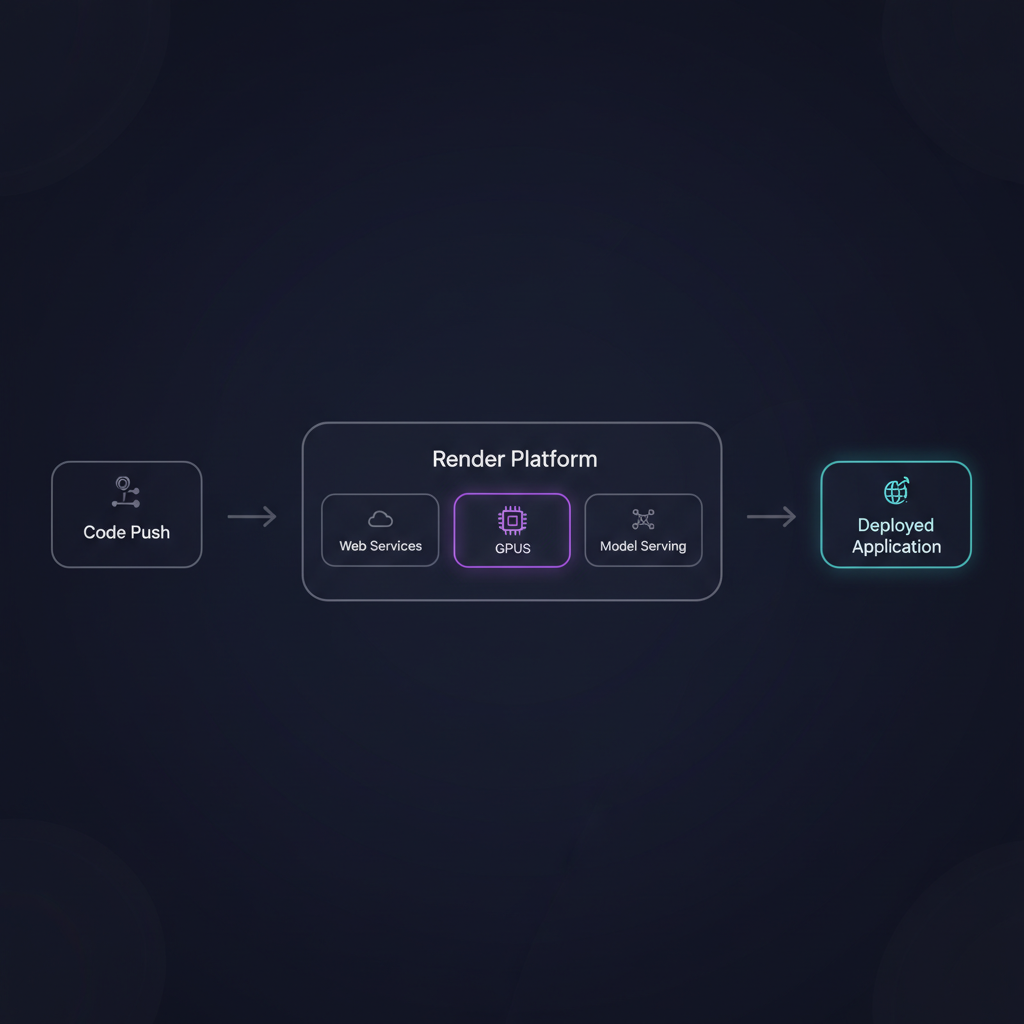
Render's bet is that developers shouldn't have to become infrastructure experts to deploy AI-powered applications. The same principles that made Render popular for web apps — push to deploy, managed infrastructure, straightforward pricing — are now being applied to GPU workloads and model serving.
Ojus explained how Render is approaching GPU availability and making it accessible without the complexity that typically comes with provisioning GPU instances. Instead of forcing developers to work through instance types, availability zones, and spot pricing, Render is abstracting those decisions into a higher-level interface.
The goal is a workflow where deploying a model-serving endpoint feels as natural as deploying a web service. That's a concrete shift from the current state of affairs, where GPU compute often means dropping into lower-level infrastructure tooling like raw VM provisioning or Kubernetes cluster management.
Developer experience still wins
The clearest theme from the conversation is that developer experience remains the differentiator — even as the underlying workloads get more complex. The teams building AI products are often the same teams that were building web apps recently. They don't want to re-learn infrastructure from scratch just because their stack now includes a model.
Ojus made the case that the developer experience gap in AI infrastructure is where the biggest opportunity lies. The raw compute is increasingly available from multiple providers. What's missing is the layer that makes it usable without deep DevOps expertise.
The platforms that win developer adoption are the ones that reduce time-to-production, not the ones that offer the most configuration knobs.
What's next for AI infrastructure
The conversation also touched on where cloud infrastructure is heading more broadly. As AI workloads become a larger share of total compute demand, platforms need to evolve their pricing models, scaling behavior, and resource management — particularly around GPU scheduling and idle cost reduction.
Render is positioning itself as the platform that grows with developers — from side project to production AI workload — without requiring a migration to a different stack as complexity increases. That continuity matters. One of the biggest friction points in the current toolchain is the gap between "easy to prototype" and "ready for production," where developers often have to switch from a managed platform to lower-level infrastructure.
Ojus was candid about the challenges ahead, including GPU supply constraints and the need to build tooling that keeps pace with how quickly the AI space is evolving. The direction, though, is straightforward: make cloud infrastructure for AI as approachable as cloud infrastructure for web apps has become.
Simplicity as a strategy
Render isn't trying to out-feature the hyperscalers. They're betting that simplicity and developer experience will win the next wave of cloud adoption, just as those qualities drove adoption of platforms like Heroku and Netlify before them. For developers building AI products who don't want to become infrastructure specialists, that's a compelling pitch.
This interview was recorded at HumanX 2026 in San Francisco.