The best thing about using OpenClaw: Constant improvement via ChatOps
Voice messages from your phone, transcribed and executed by your AI agent, which then upgrades itself. The ChatOps self-improvement loop.

For years, the promise of a personal AI assistant has been pitched as something futuristic --- a system that knows your context, is always available, and gets smarter the more you use it. I've been running OpenClaw for a while now, and I can tell you: that future arrived quietly, running on a small desktop computer in my office.
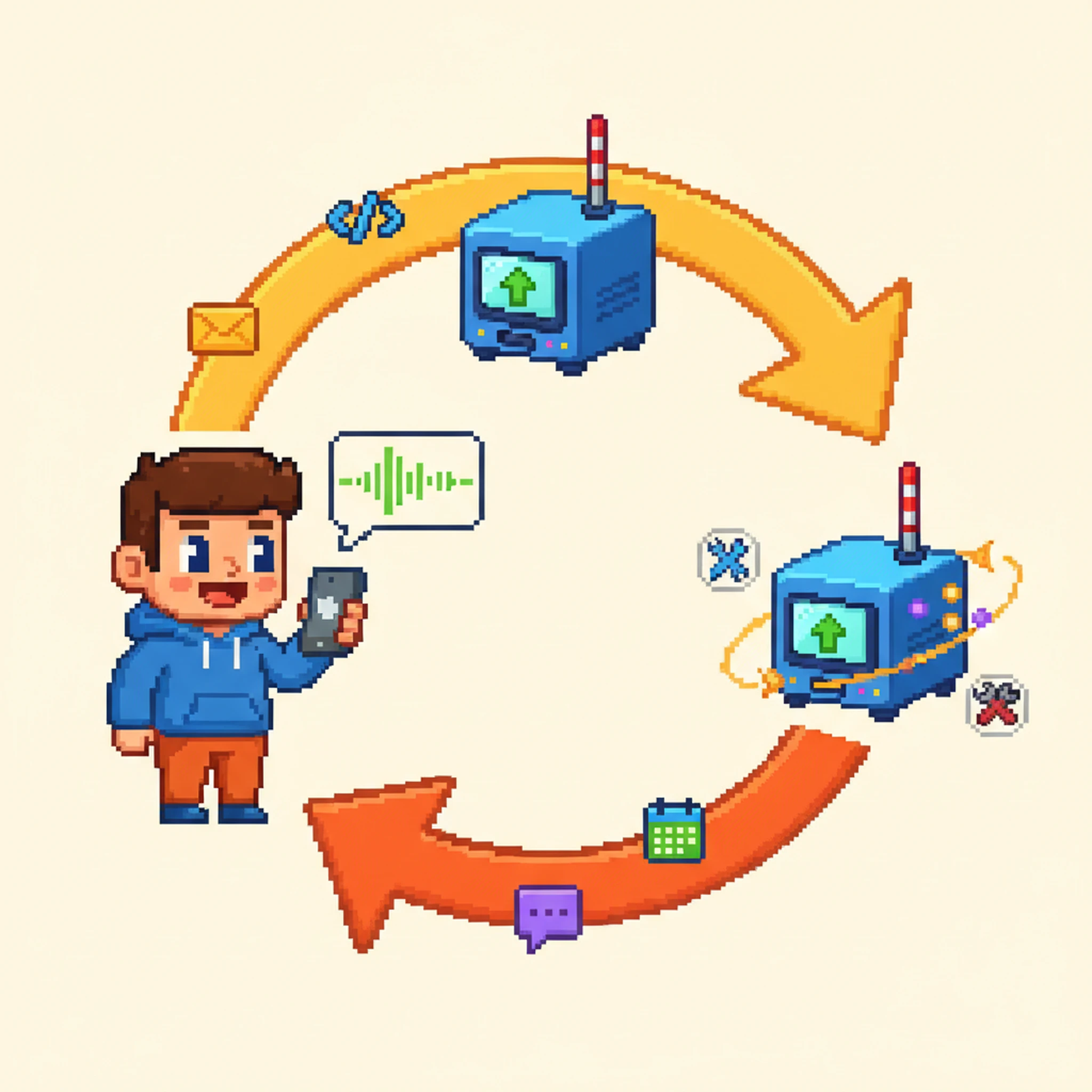
But the killer feature isn't what most people would expect. It's not the code generation or the task automation. It's the ChatOps-driven self-improvement loop --- the fact that I can tell my agent what's broken, what's missing, or what I need next, and it goes and fixes or builds it. From my phone. While I'm waiting at a traffic light.
What is OpenClaw?
OpenClaw is an open-source autonomous AI agent that runs on dedicated hardware --- specifically, a System76 Meerkat. It's secured with Tailscale for private networking and Guardian for access control. It's not a cloud service I'm renting. It's a machine I own, running software I control, connected to the tools and repos that make up my daily workflow.
Think of it as a coworker who never sleeps, never loses context, and is always one message away.
The Always-Available Pattern
Here's where it gets interesting. OpenClaw is wired into Discord, which means I can reach it from anywhere --- my desk, my couch, or the pickup line at my kids' school.
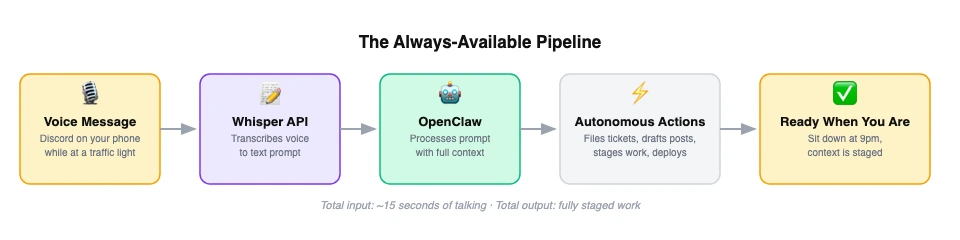
The workflow I use most often looks like this: I open Discord on my phone, hold down the record button, and speak a voice message. OpenClaw picks it up, runs it through OpenAI's Whisper API for transcription, and then processes the resulting text as a prompt. It has full context about my projects, my repos, my priorities. So when I say something like "Draft a blog post ticket about the new email search capability and outline the key points," it doesn't just acknowledge the request --- it goes and does it. It files the ticket. It drafts the outline. It stages the work.
This matters because the bottleneck in my day is almost never the execution of a task. It's the gap between having an idea and getting it into a system where it can be acted on. How many ideas have you had in the car that evaporated by the time you sat down at your laptop? OpenClaw collapses that gap to the length of a voice message.
By the time I get back to work --- even if that's 9pm after the kids are in bed --- I can sit down and say "pick up that task" and everything is already staged. The context is there. The tickets are filed. The drafts are started. I'm not rebuilding mental state from scratch. I'm picking up momentum.
The Self-Improvement Loop
This is the part that genuinely changed how I think about personal tooling.
When something about OpenClaw annoys me, I tell it. And it fixes itself.
Here's a real example: OpenClaw has a skill for sweeping my email --- summarizing what's important, flagging things that need action. It was running on a cron job, and the timing was wrong. It was firing at inconvenient times, the summaries were too verbose, and it was missing certain categories of mail I cared about. In the old world, I'd open a ticket, context-switch into the codebase, figure out what to change, test it, deploy it. Thirty minutes minimum, probably more like an hour once you account for the mental overhead.
Instead, I sent a voice message: "Your email sweep skill is running on a cron job and I hate it. Here's what's wrong with it --- the timing is off, the summaries are too long, and it's missing newsletters. You keep repeating emails. Fix it."
OpenClaw understood the instruction, made the changes, and deployed them. The next sweep was better. Total effort on my part: maybe fifteen seconds of talking.
Here's another one. I realized I needed the ability to search across all my email instantly --- not just the recent sweep results, but a full-text search over everything. So I told OpenClaw: "I need you to have a new capability so you can search all my emails instantly. Go build this tool and put it in a Git repo."
And it did. It scaffolded the tool, wrote the integration, put it in a repo, and made it available as a new skill. I reviewed the code, gave some feedback, and it iterated. Within a day I had a capability that would have taken me a weekend to build manually.
Why This Is High-Leverage
The leverage here is almost absurd when you step back and look at it. The input is a sentence or two, spoken into my phone while I'm doing something else. The output is a meaningful upgrade to the system's capabilities.
This inverts the normal economics of personal tooling. Usually, improving your tools costs time --- time you could be spending on actual work. So most people don't do it. They live with the friction. They tolerate the cron job that fires at the wrong time. They wish they had a search feature but never build one.
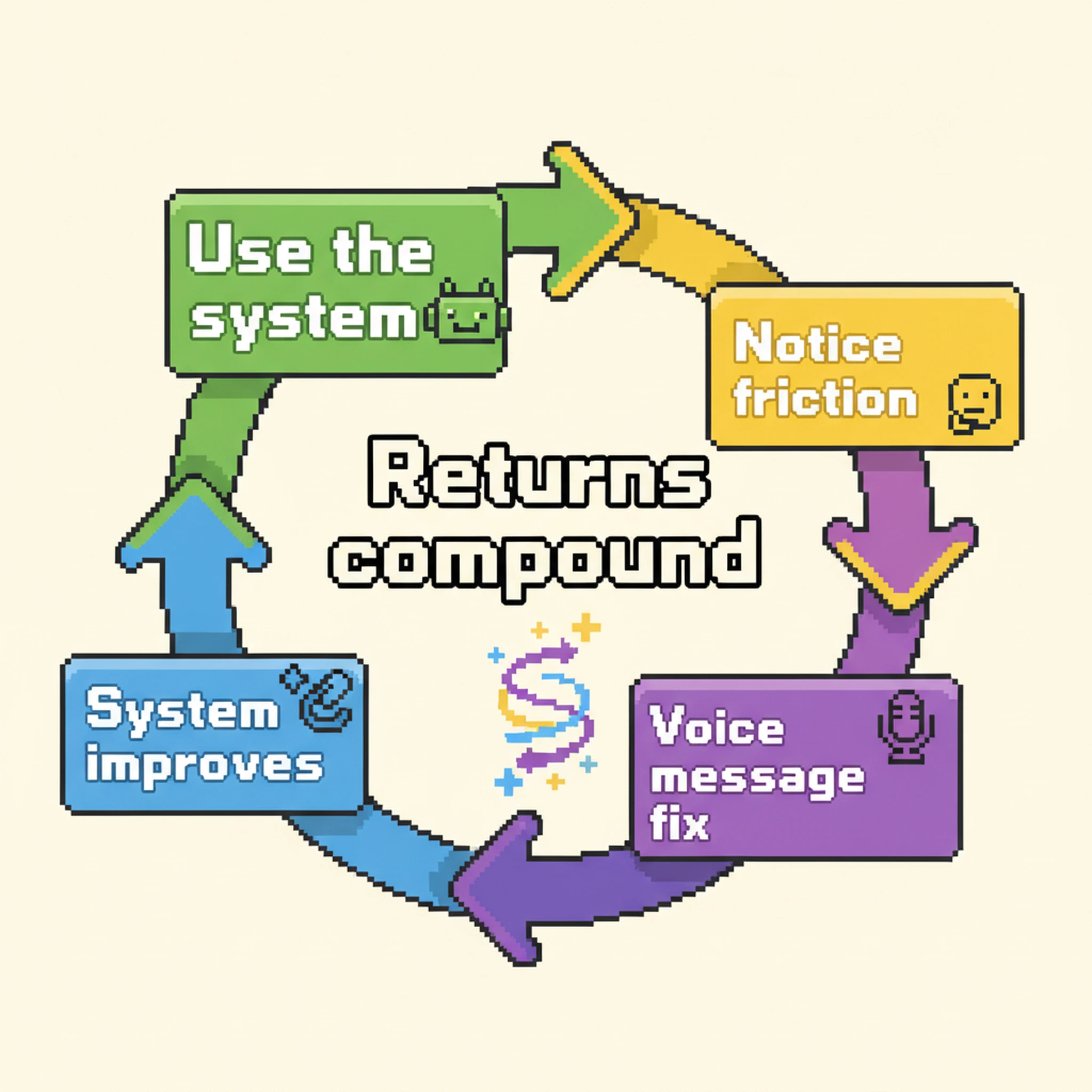
When the cost of improvement drops to a voice message, you stop tolerating friction. You fix things the moment they bother you. And because each fix makes the system more capable, the returns compound. The system gets better at understanding your instructions. It gets better at executing autonomously. It handles more of the routine work, which frees you up for the work that actually requires your judgment.
This is the flywheel: use the system, notice friction, tell the system to fix the friction, the system gets better, you use it more.
What This Means for Personal AI Agents
I think most people are thinking about AI agents wrong. The conversation is dominated by "what can the agent do out of the box" --- what tasks does it support, what integrations does it have, how good is it at coding or writing or research.
Those things matter. But they're table stakes. The thing that actually determines whether an AI agent becomes indispensable is whether it can improve itself based on your feedback, in the context of your actual workflow, without requiring you to drop what you're doing and play engineer.
OpenClaw isn't impressive because it came wit2h every feature I needed. It's impressive because it builds the features I need when I ask for them. The system I'm running today is meaningfully different from the one I started with, and almost all of those improvements came from casual voice messages sent between meetings, during errands, or late at night.
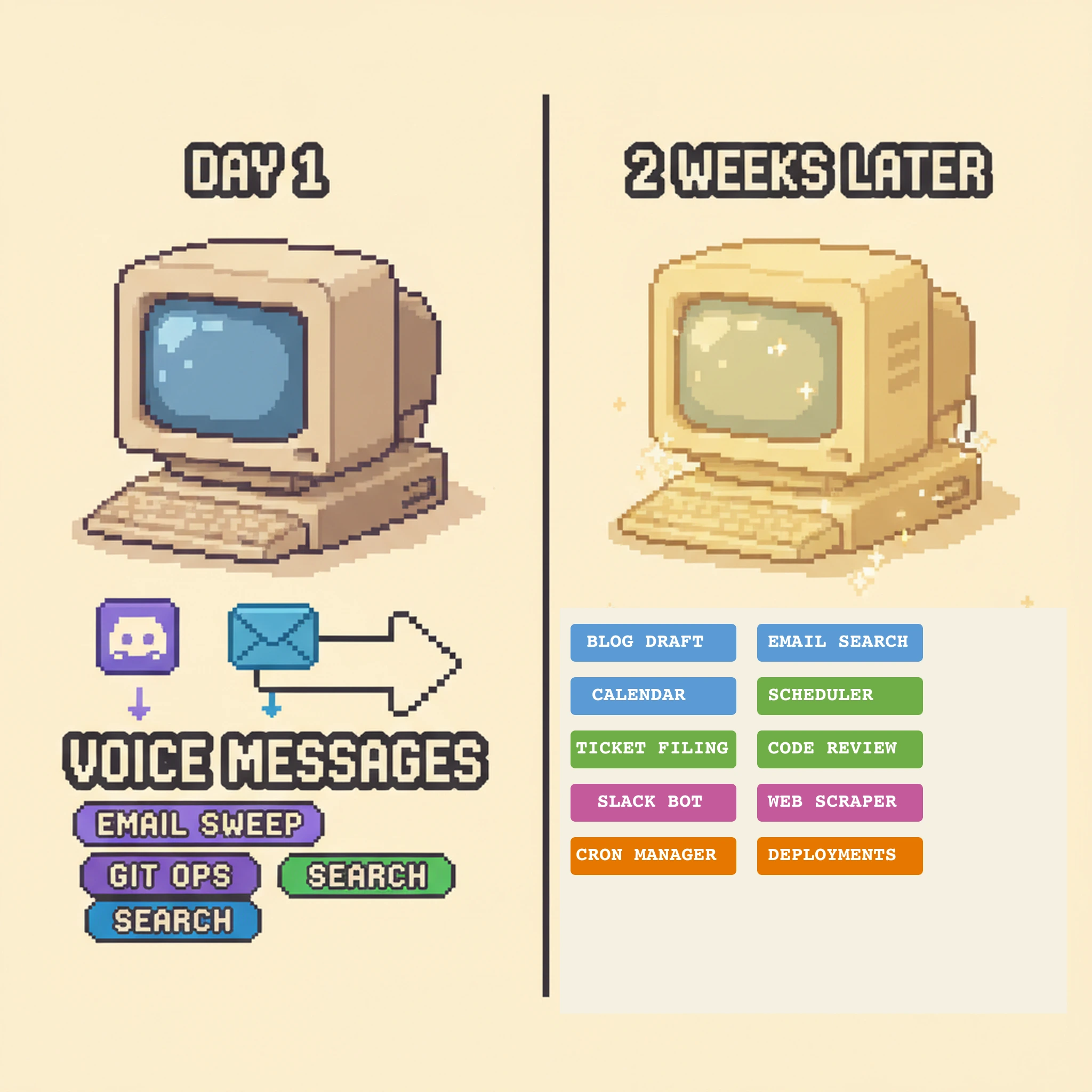
The system I'm running today has capabilities that didn't exist two weeks ago — capabilities I built in the time it takes to wait for a coffee order. Each one makes the next improvement easier, because the system itself is better at understanding what I need. That compounding loop is the real product. Not the agent you install. The agent it becomes.