Tailscale's Remy Guercio on what comes after token maxing
Tailscale's Remy Guercio tells Michael Grinich why the next 12 months of AI are ROI maxing: cost per task, model experiments, and what a gateway can see.

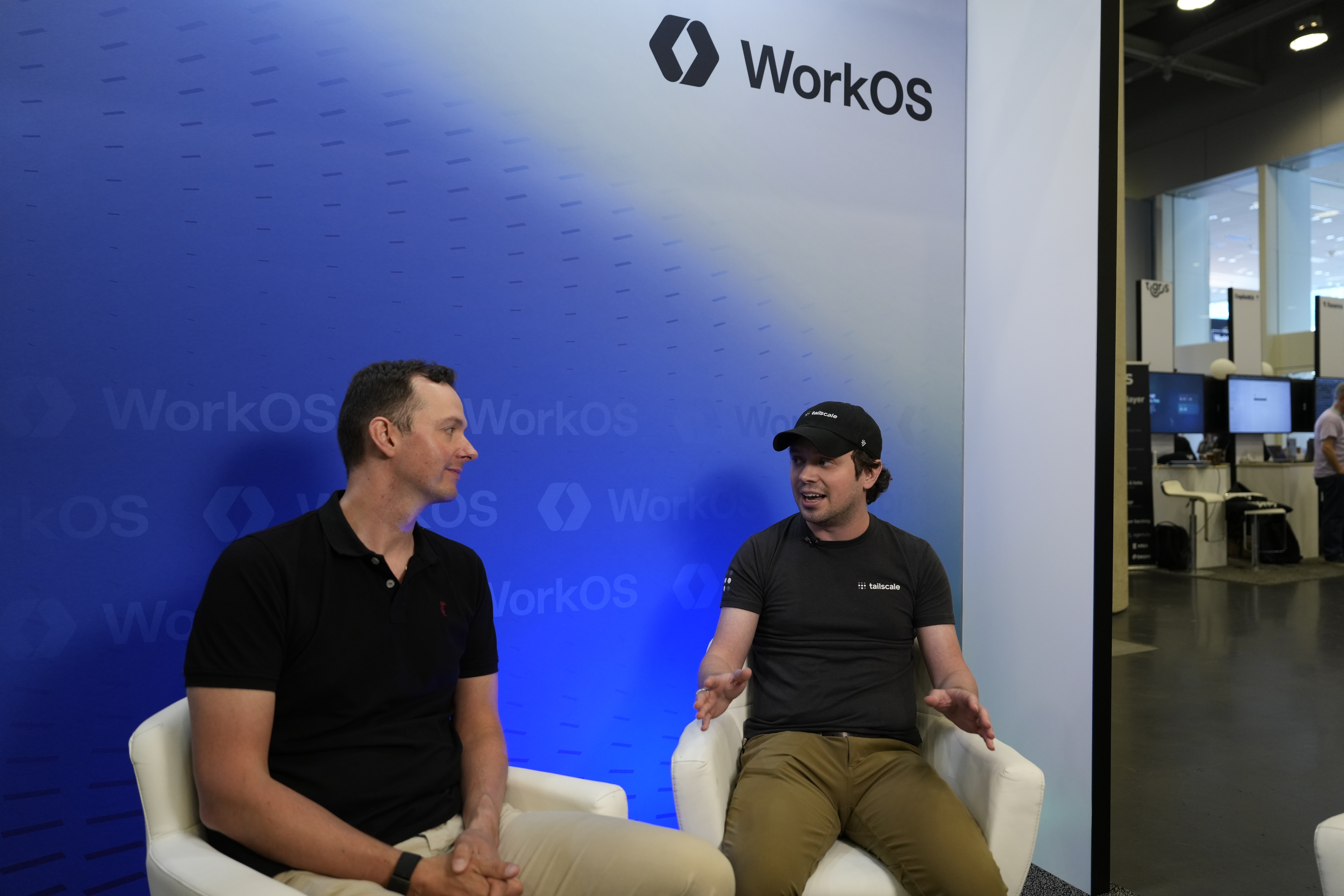
The bills arrived. At the AI Engineer World's Fair 2026 in San Francisco, Michael Grinich sat down with Remy Guercio, who works on strategic projects at Tailscale and on its AI gateway, Aperture. Guercio's forecast for the year ahead fits in one line: the last 12 months were token maxing, and the next 12 are ROI maxing.
Token maxing was the point
Guercio doesn't mean "token maxing" as a knock. He means the last year of finding out what you can actually do with a million-token context: stuffing everything into a model, and letting coding agents go find the right parts of files to fill that window.
Inside Tailscale, that exploration was a step change. Twelve months ago most of the company was doing tab autocomplete; now engineers run agents constantly, and usage is counted in billions of tokens rather than tens or hundreds of millions. What mattered was not the token count. A subset of engineers had a backlog of ideas they had never had time to try, enough time to review something, never enough to sit down and build it, and agents let them try several approaches and then look at the results. Guercio's hope is that this produces better software, because people can try many paths and pick a good one, rather than more software that pushes every path onto the user.
The pushback is arithmetic
Then the invoices land. An OpenAI bill, an Anthropic bill, a Gemini bill, plus Devin and Cursor, all arriving at the same finance team. Six months or a year of enthusiastic adoption shows up at once, and finance wants the number explained before anyone argues about ROI.
Guercio's read is that most organizations are not asking for granular attribution down to a project or a single PR. Some are, and Tailscale sees them, but they are the minority. The common request is simpler and harder to satisfy: what is generating these bills at all.
Cheaper per token, more expensive per task
Per-token price turns out to be the wrong denominator. Guercio points at the Artificial Analysis cost-per-task charts, where open source models are trending down, and notes that Sonnet 5, newly released, lands more expensive on a per-task basis even though it is cheaper to buy. A model can be cheap per token and still cost more per finished job if it takes more turns to get there.
Grinich reached for the Concorde: it burned enormous amounts of fuel, but it was efficient per mile because it went so fast that a transatlantic flight took about three and a half hours. You can burn gas twice as fast and still come out ahead. That is the calculation most teams have no data to run.
The place it bites hardest is the harness. Aperture reports average cost per million tokens on a per-user, per-model, or per-harness basis over any period, which is how you find out that a particular harness does not cache as well as it should, or that a model takes too many tokens to work out an answer. Optimization tricks carry their own bill. Guercio mentions vLLM's semantic router, which sends each request to a model based on what the prompt appears to need, as one of the approaches teams talk about. He also notes that a recently popular prompt-caching and prompt-optimization project would in many cases blow up your cache. Switching models mid-task does the same thing, invalidating the cache completely.
One big bill is not a strategy
Faced with all this, the most common move Guercio sees is consolidation: pick one provider, get one bill, figure it out from there. He thinks it is the wrong call. You trade several bills for one really big one, and understand it no better than before.
The case for consolidating is real: fewer contracts, volume commitments, one security review. What it costs you is the discovery. If everything is cut off at one vendor, an engineer cannot come back and say GLM 5.2 worked better for this specific job. With traffic running through a gateway, that claim is checkable. You look at the numbers and confirm it was not just vibes, that the model really did do the work better or cheaper.
Visibility comes before evals
Evals are the obvious answer to whether any of this is worth it, and they run out of road quickly. Guercio's example: how do you write an eval for what your recruiting team does, or your finance team? It is an art, and the first step is seeing what is happening at all.
That is the architectural bet behind Aperture, which is currently in beta. It is a reverse proxy sitting between LLM clients, including coding assistants, chat interfaces, and autonomous agents, and upstream providers like OpenAI, Anthropic, and Google. In Guercio's framing it is both an LLM gateway and an MCP gateway, positioned between your agents and whatever endpoints they call. Identity comes from the Tailscale layer, and provider keys are injected from server configuration rather than living on developer laptops. Requests route by model name, so an existing tool joins by changing a base URL. Every request is captured with user attribution, model, and token counts including cached and reasoning tokens, then aggregated by user, model, and period.
Owning that chokepoint is what makes the governance work cheap. Budgets and per-user spending limits sit at the proxy, as do guardrails that scrub PII or restrict tool declarations before a request leaves the network. Connectors go further, proxying external MCP servers and HTTP APIs so agents never carry their own credentials. Guercio frames the access side plainly: customers keep asking which teams and people can reach which models, and on what budget. The goal is less about capping spend than understanding it well enough to improve the return.
Labels are the ROI primitive
The next thing Tailscale is shipping sounds smaller than it is: arbitrary labels sent through Aperture, so ROI analysis can be run against them, by PR, by bug report, by whatever unit a team cares about. That is what turns a token bill into a question with an answer, like what a given experiment or bug fix actually cost.
It also changes the shape of the answer. As Grinich pointed out, building ten things instead of one looks less efficient by the old measure, but if the goal is product-market fit the ROI calculation is different. Labels are what let you tell ten deliberate experiments apart from tokens someone burned checking the weather.
The line item got bigger than the laptop
Tailscale insists it isn't chasing finance as a buyer. But the comparison Guercio draws is the one every CFO is already making: AI costs a good bit more than the fully specced MacBook Pro that used to be an engineer's main expense, Grinich's $4,000 laptop, once a startling purchase. When a cost center gets that big, finance, IT, and security all take an interest, and Tailscale's stated ambition is to help customers take an adult, measured approach to it, where cost is a large component but not the only one.
The practical version, for anyone about to sit in a model consolidation meeting: get cost per task, broken out by harness, before you go. The number is not there to shut experiments down. It is what buys an engineer the room to try ten ideas instead of one.
This interview was recorded at the AI Engineer World's Fair 2026 in San Francisco.