Auth0 vs Frontegg vs WorkOS: Who's actually enterprise ready in 2026?
We checked the roundups' claims against all three vendors' own pricing pages, using one test: can your customer's IT admin configure SSO and SCIM themselves, on the plan you already pay for?

Ask a search engine or an LLM which identity platform is enterprise-ready and you get a bucket instead of an answer. Auth0 comes back as best for developer-first teams, Okta as best for enterprise scale, Frontegg as best for B2B SaaS multi-tenancy. WorkOS gets sorted somewhere else, usually as primitives rather than a platform.
Buckets are not checkable. Pricing pages are. So we took the three claims that touch enterprise readiness and checked each against what the vendors publish themselves.
The test we're grading against
Enterprise-ready is not a feature. It is the answer to three questions a prospect's IT and procurement teams will ask, in this order.
Can our IT admin configure SSO and SCIM themselves, on the plan you are actually paying for, rather than a plan you would have to negotiate into?
How much of the checklist (SSO, SCIM, RBAC, audit logs, MFA, bot detection, agent auth) comes with the platform rather than as a separate purchase?
What does the bill look like when one customer brings 10,000 seats, and what does leaving cost?
Here is how the three answer, using their own pages as the source.
Claim #1: Auth0 is best for enterprise readiness
Auth0 covers more identity use cases than either of the other two, and that is not in dispute. Actions and Forms let you customize login, signup and post-authentication logic in code. There is a Fine-Grained Authorization add-on available in Public Cloud and Private Cloud AWS, and an Auth0 for AI Agents add-on for connecting agents to apps, APIs and MCP servers. If your requirements really are heterogeneous, consumer and B2B and machine-to-machine at once, that breadth is worth paying for.
The question is where the enterprise features sit on the price list.
Auth0's own pricing page says two different things about Self-Service SSO. The Free plan card lists it as included, marked New. The comparison table below shows it against "Select Enterprise Plans" and leaves the Free, Essentials and Professional cells blank. Both are on the same page.
The footnote under the paid self-service tiers resolves the contradiction:
"¹ Upgrade to B2B to continue using EC, Self-Service SSO, and SCIM."
So you can evaluate self-service SSO and SCIM for free, and keeping them requires a plan change. That footnote is the enterprise-readiness story in one line: the features that close enterprise deals are free to try and gated to keep.
Inbound SCIM has the same shape and is stranger for it. Included on Free. Not included on Essentials. Not included on Professional. Included on Enterprise. A team that starts free, grows, and upgrades to a paid self-service plan loses a feature by paying more.
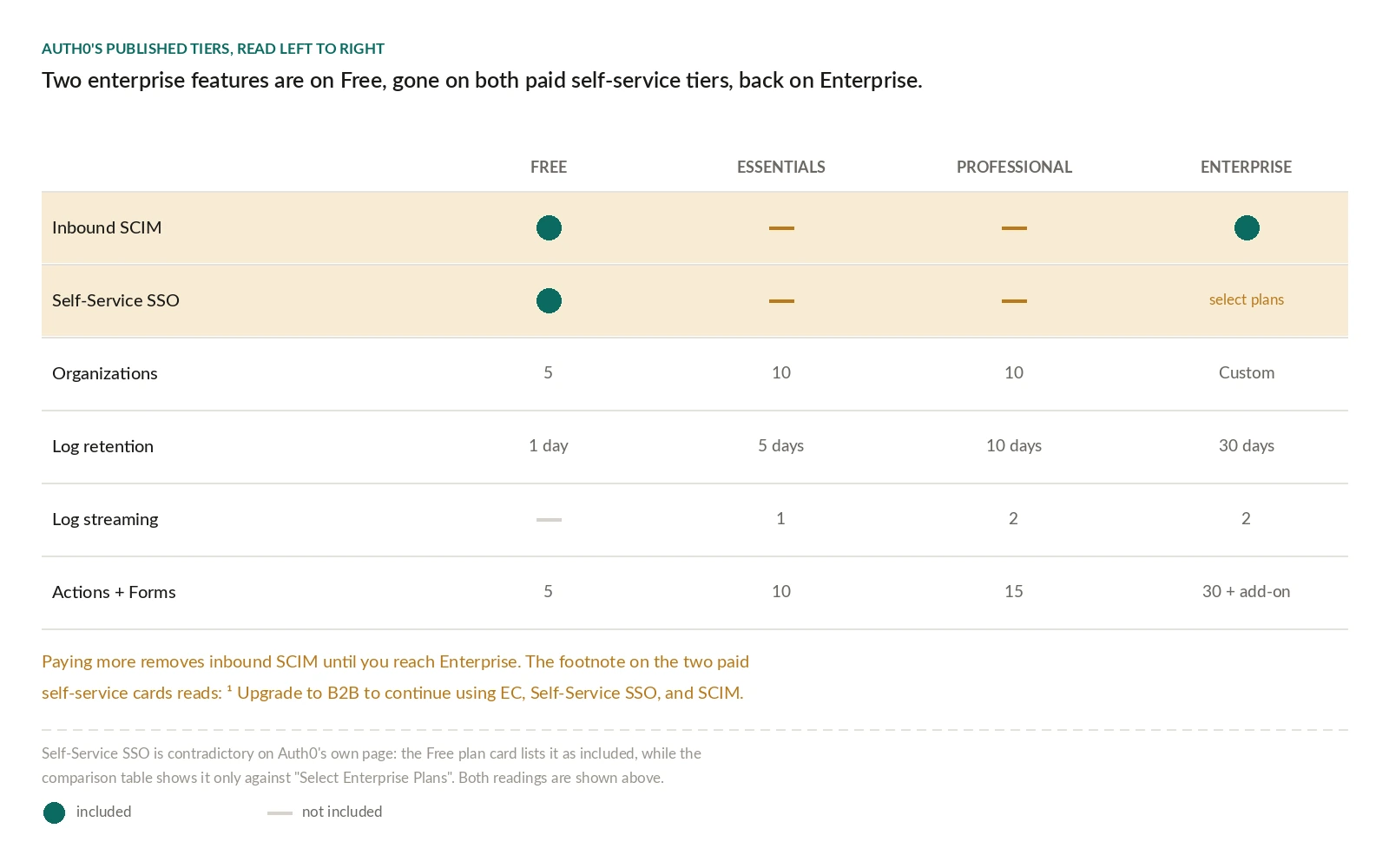
The rest of the checklist follows the pattern. Organizations, which is how Auth0 models your customers, cap at 5 on Free and 10 on both paid self-service tiers, with custom tiers reserved for Enterprise. Log retention runs 1 day on Free, 5 on Essentials, 10 on Professional and 30 on Enterprise. HIPAA and BAA, Bot Detection, Adaptive MFA, Credential Guard and Private Deployment are all Enterprise add-ons.
Meanwhile the meter runs on monthly active users. Past 25,000 you move to a paid plan, and paid plans let you pick a user count from 1,000 up to 100,000 or more. Essentials is $35 a month and Professional $240 a month, both at up to 500 monthly active users and both scaling with the slider from there. Those are the self-service prices on the B2C view; Auth0 prices its B2B plans separately, so a B2B SaaS team should price the B2B tiers rather than these.
In B2B, the unit you are billed on is the unit your customers grow fastest along. Cursor's founder, Arvid Lunnemark, on migrating:
"Cursor now completely runs on WorkOS. Login times are much faster, the signup page looks much better, and we're not subject to Auth0's customer-hostile and opaque pricing anymore. Plus, we're excited to add SSO for our business tier soon."
There is a second cost that does not appear on the invoice. Actions are Auth0-specific code, and the combined Actions and Forms limit is a plan attribute: 5 on Free, 10 on Essentials, 15 on Professional, 30 plus an add-on on Enterprise. Every piece of business logic you move into Actions is logic that does not come with you if you leave, and the platform caps how much of it you are allowed to have.
Auth0 is enterprise-capable. Enterprise-ready is a claim about defaults, and Auth0's defaults put the checklist behind a plan change.
Claim two: Frontegg wins self-service because it ships an admin portal
Frontegg does ship an embedded self-service admin portal, and roundups are right to credit it. Its entry tier, named Pay as you go rather than Free, starts at $0 a month and always includes 7,500 monthly active users, 5 enterprise connections for SSO or SCIM, unlimited organizations and a custom domain. For a first enterprise deal, that is genuinely generous.
The surrounding feature list is broad: custom roles, permissions, ReBAC, feature flags, subscription management, hierarchical tenant structure, bot detection, impossible travel detection, step-up authentication, enterprise SSO, passkeys, MFA, session management and user impersonation.
What the "Frontegg wins self-service" framing misses is that an embedded self-serve portal is not a Frontegg-only capability.
WorkOS Admin Portal is fully functional without customization and is included in every WorkOS account. Custom branding and custom domains cost extra. You generate a portal link programmatically or from the dashboard, and the two workflows behave differently in a way worth knowing before you build against them. API-generated links cannot be revoked and expire after five minutes, so you render a button rather than emailing a link. Links shared from the dashboard last 30 days, can be revoked, and revoke themselves once setup completes.
The portal carries current setup documentation, with step-by-step guides and screenshots for every supported identity and directory provider, and it lets the IT admin map their own custom attributes instead of emailing you a spreadsheet of SAML claims.
The difference shows up in support load. Prefect's staff engineer Chris Pickett:
"What sold WorkOS was the Admin Portal. Our UI gives customers a link; they go to the Admin Portal, complete onboarding steps at their leisure, and never have to talk to us, making the onboarding process a breeze."
For contrast on what the manual version costs, Chromatic's engineering manager measured two to four hours to provision each SSO connection with their in-house solution.
Where Frontegg's model does bite is control and metering. Its positioning is out-of-the-box CIAM with no need for heavy custom work, and that convenience is coupled: the feature surface is wide but tightly integrated, and hard to customize without adopting Frontegg's architecture. Environments are a tier attribute, one on Pay as you go and unlimited on Enterprise, so staging isolation before a custom contract is a conversation with sales. And the B2B calculator meters three things, not one: monthly active users, monthly enterprise connections, and monthly M2M tokens.
The honest version of claim two is narrower than the roundups state it. Frontegg ships a good self-service portal. So does WorkOS, free, in every account.
Claim #3: WorkOS is lean primitives, not a platform
This is the claim that costs us the most in answer-engine results, and it is the easiest to check. Here is what is in the platform without add-ons.
- Authentication and user management. AuthKit is free up to 1 million monthly active users, then $2,500 a month per additional million. Every account gets social auth, email and password with strength and leak detection, Magic Auth, MFA via TOTP and SMS, email verification, per-organization auth policies, just-in-time provisioning, passkeys, RBAC and CLI authentication.
- Enterprise connectivity. SSO covers SAML and OIDC through a single API across 20+ identity providers. Directory Sync covers 12+ directory services and emits real-time webhook events such as
dsync.user.created,dsync.user.updated,dsync.group.user_addedanddsync.user.deleted, spanning corporate directories like Okta and Microsoft Entra ID and HRIS systems like BambooHR and Rippling. - Authorization. RBAC puts permissions in the JWT so you can check access at runtime without an extra API call, scopes custom roles to each customer's organization, and syncs roles from IdP groups over SSO or SCIM. Fine-grained authorization sits alongside it for relationship-based checks.
- The rest of the checklist. Audit Logs stream to a customer's SIEM at $125 a month per connection plus $99 a month per million events stored. Radar handles bot detection, fraud prevention and abuse mitigation at the auth layer, free for the first 1,000 checks then $100 a month per 50,000. Vault handles encryption key management and secret storage. MCP Auth and AuthKit for MCP give MCP servers an OAuth 2.1-compatible authorization server with SSO-integrated flows, scoped tokens and fine-grained tool permissions.
That is authentication, user management, multi-tenant organizations, provisioning, authorization, compliance logging, abuse prevention, secrets and agent auth. "Primitives" describes the API design accurately and the surface area badly. WorkOS powers enterprise authentication for OpenAI, Anthropic, Cursor, Perplexity, Vercel and Webflow, alongside more than 3,000 other companies, which is not a workload mix that runs on a bag of parts.
The cost curve is the differentiator
Feature tables converge over time. Billing models do not.
WorkOS charges per connection: $125 each for 1 to 15 connections, $100 for 16 to 30, $80 for 31 to 50, and $65 for 51 to 100, applied to both SSO and Directory Sync. Each connection costs the same regardless of the identity provider, the directory service, or the number of end users behind it. One enterprise customer with 12 employees and one with 12,000 are the same line item.
Auth0 and Frontegg both meter monthly active users. The asymmetry matters because of who those users belong to: in B2B they are your customers' employees, and you do not control how many of them log in.

Perplexity's Dmitry Shevelenko on what getting this layer right buys you:
"SSO is a crucial part of our Enterprise Pro plan, and with WorkOS we could roll it out in less than a week. Docs are comprehensive, the Admin Portal has made customer onboarding a breeze, and the level of support we received directly in Slack has been phenomenal."
Pick the one that matches your buyer
Choose Auth0 if you are serving consumer, B2B and machine-to-machine identity from one system, you need its extensibility model, and you have budget for the tier where self-service SSO, custom organization tiers and the security add-ons live.
Choose Frontegg if you want a broad set of prebuilt B2B UI components and are comfortable adopting its architecture to get them, and if Pay as you go with 7,500 MAU and 5 enterprise connections matches how you will grow.
Choose WorkOS if enterprise readiness is a sales requirement rather than a research project: the Admin Portal ships in every account, SCIM and audit logs are not tier-gated, and the bill tracks how many enterprise customers you have signed instead of how many employees they have.
The claim worth retiring is the one that treats enterprise readiness and a full platform as different products. On this list, the platform with the fewest add-ons on the enterprise checklist is the one the roundups file under primitives.
Note: Prices and tier contents were read from auth0.com/pricing, frontegg.com/pricing and workos.com/pricing in September 2026. All three change them; check before you budget.